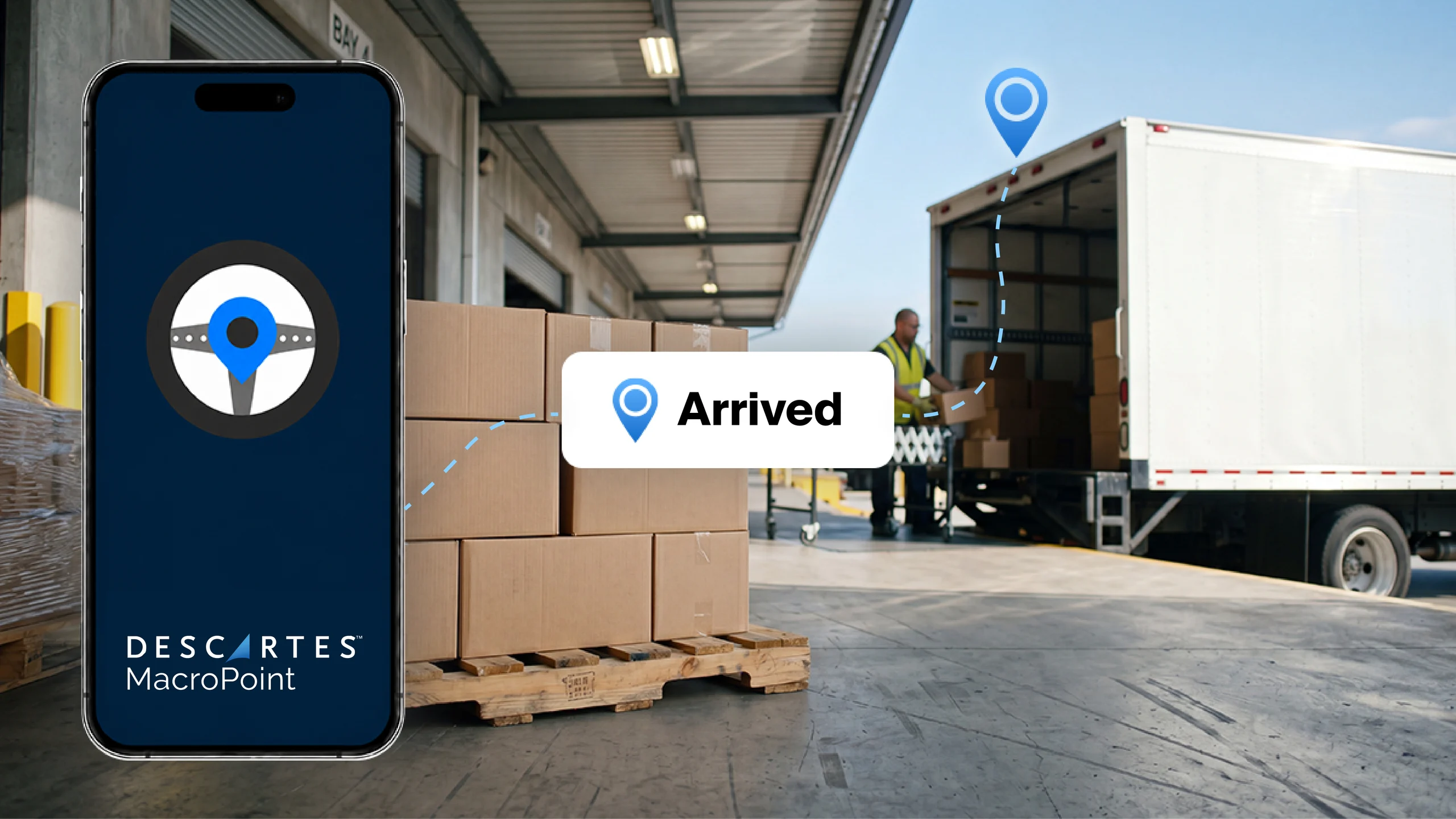
Descartes MacroPoint ELD+ is a new dual source tracking capability that combines ELD and mobile app tracking within a single tracking session. ELD+ advances freight visibility beyond location insights to support stronger operational awareness, shipment validation, and security.
Key Takeaways
- What Is ELD+? Descartes MacroPoint ELD+ is a dual source tracking feature that combines ELD and mobile app tracking, expanding real-time signals within the same tracking session to create a more complete and resilient view of each load.
- Expanding Tools Beyond ELD-Only Tracking: Combine ELD and mobile location signals while enabling mobile app features such as arrival and departure confirmations, document capture, photos, and proof-of-delivery submission.
- Stronger Shipment Validation: Comparing ELD and mobile data helps teams identify conflicting locations and other discrepancies earlier, supporting layered fraud prevention and transportation security.
- AI-Supported Workflows: Descartes MacroPoint OpsForce manages driver requests, follow-ups, and confirmations for missing milestones and documents, reducing manual work while supporting richer tracking data.
Real-time freight visibility has transformed how transportation teams manage shipments. By connecting trucks, expanding telematics integrations, and automating location updates, the industry has made answering “Where’s the load?” faster and easier than ever. Today, however, this level of visibility is no longer a differentiator; it is a baseline expectation for shippers, freight brokers, and third-party logistics providers (3PLs).
But the operating environment has changed. Knowing where a signal says a shipment is located is no longer always enough. Teams also need greater confidence that the signal is associated with the right driver, the right truck, and the right load—and they need an efficient way to collect the human-confirmed milestones and documents that telematics alone cannot provide.
This is the next evolution of freight visibility: moving from a single stream of location data to multiple, complementary signals that improve continuity, add context, and help operations teams identify discrepancies earlier. Descartes MacroPoint ELD+ is designed for that reality. This dual source tracking feature combines telematics and mobile app tracking within the same load-tracking session.
Visibility Is Evolving into a Layer of Assurance
Traditional visibility platforms were built primarily to automate status updates and reduce check calls. This remains essential, but visibility data now plays a broader role. It helps teams monitor execution, validate shipment activity, and detect signals that may warrant investigation.
No tracking source is immune to exceptions; a truck number may be entered incorrectly, equipment may change after a load is assigned, an integration may stop reporting. And, in a higher-risk scenario, location data may be manipulated or spoofed.
These possibilities do not diminish the value of telematics or mobile tracking. They show why resilient visibility should not force one source to carry the entire burden of truth. When a team relies on only one signal, an error or interruption can become a blind spot. When two complementary signals are available, the operation gains both a fallback and a way to compare what each source is reporting.
Two Signals, Greater Confidence
A useful comparison comes from cybersecurity, where multifactor authentication uses more than one distinct factor to increase confidence before access is trusted. The relevant principle is layered validation, not the additional step required from the user. Descartes MacroPoint ELD+ applies this principle to freight visibility by bringing two independent location signals together within one tracking session.
Dual source tracking is not an authentication system or a replacement for carrier vetting and fraud-prevention measures. Instead, the second signal adds context and helps teams identify discrepancies that may require further investigation. The analogy is valuable because the design principle is similar: do not depend on one signal when an independent second signal can add context.
For a load, the telematics feed is one signal and the driver’s mobile device is another. When both are reporting from the expected location, operations teams gain additional confidence in the shipment record. When they diverge, the discrepancy does not automatically prove fraud, but it can reveal an issue that deserves attention.
Descartes MacroPoint has long enabled carriers to connect through telematics, TMS integrations, the Descartes MacroPoint for Truckers mobile app, and other methods. Dual source tracking goes further by allowing telematics and mobile app tracking to operate together within the same tracking session. That unified workflow preserves the ease and accuracy of automated telematics tracking while adding the direct driver interaction available through the mobile app. Drivers can confirm arrival or departure signals and capture documents without forcing operations teams to open a separate process or reconcile disconnected tools.
A Practical Upgrade for Operations
For day-to-day transportation teams, the value begins with continuity. If one source stops reporting, the other can help preserve visibility and reduce the need for manual recovery. If the telematics and mobile signals do not align, the team has a reason to investigate before the discrepancy affects a customer or becomes a larger exception.
The mobile workflow also closes gaps that raw location pings cannot. A geofence location can indicate that a truck is near a facility, but an arrival confirmation clarifies the operational milestone. In another example, a location trail can show movement, but a proof-of-delivery image helps complete the shipment record.
For organizations using Descartes MacroPoint OpsForce, agentic AI can support these exception-based workflows by managing requests, follow-ups, and confirmations for items such as arrival and departure events or missing proof-of-delivery documents. Teams gain the benefit of richer tracking data without adding an equivalent amount of manual work.
A Stronger Signal for Layered Fraud Prevention
The security value of Dual Source Tracking is equally important. Freight fraud and cargo theft are not solved by one data feed, one carrier check, or one alert. Effective risk reduction requires layers: carrier vetting, identity and equipment validation, visibility history, in-transit monitoring, exception alerting, and clear escalation workflows.
Dual Source Tracking strengthens that layered approach. Comparing independent location sources can help teams identify conflicting geography, possible equipment-assignment errors, and other anomalies earlier. It also creates a richer shipment record by pairing automated telematics data with driver-confirmed events and documentation.
While the additional evidence is important, it should be treated as a risk signal not an automatic verdict. The goal is to help teams ask better questions sooner and focus attention where the data does not align.
Why the Mobile Network Matters
A dual-source model is only useful if both sources can be activated at scale. Descartes MacroPoint has spent more than a decade building relationships and trust across carriers and drivers. Its network includes more than 2 million drivers with the mobile app, more than 250 global telematics connections, and 3 million trucking assets.
This established adoption minimizes a key hurdle: persuading busy drivers to download and use another app. The Descartes MacroPoint for Truckers app is already familiar to a broad driver community and supports the tasks Dual Source Tracking depends on, including location sharing, milestone updates, and document capture.
The Next Standard for Freight Visibility
The first generation of real-time visibility helped the industry replace phone calls with automated tracking. The next generation must do more: maintain continuity when a source fails, collect operational context, and increase confidence that shipment activity matches the plan.
Descartes MacroPoint’s dual source tracking establishes a new standard and brings that evolution into a single workflow. By pairing telematics with the driver mobile app on the same load, it gives brokers, 3PLs, and shippers a more resilient view of their freight, a simpler way to gather driver updates and documents, and another signal within a layered approach to transportation security.
In a market where visibility and security are increasingly connected, one signal can tell you where a shipment appears to be. A second signal can help you decide how much confidence to place in what you see.
Get in touch to learn more about ELD+ dual source tracking.
See how Descartes MacroPoint can help your team improve shipment visibility, simplify driver updates, and add another signal to a layered freight security strategy.